Page 474 of 703
Declassified CIA Family Jewels memo, June 2007 release. OCR transcribed by tesseract.js.
MORI DOCID 1451843
Page image
Source scan from the National Security Archive copy of the document. Open full PDF at this page →
OCR transcript4,002 chars
MORI DocID: 1451843

BALTIMORE NEWS AMERICAN
12 APR 1973

JOHN P. ROCHE

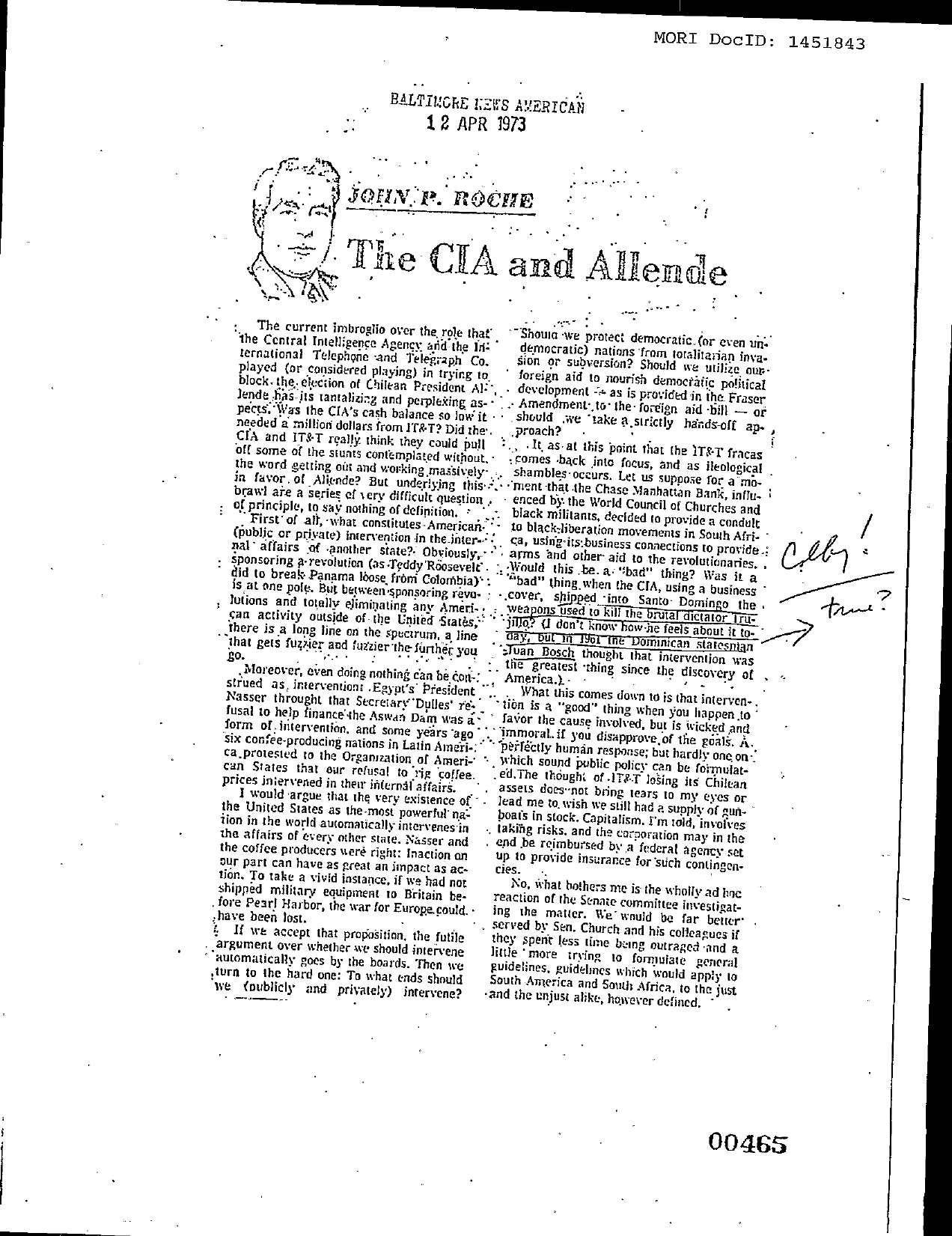
The CIA and Allende

The current imbroglio over the role that the Central Intelligence Agency aid the International Telephone and Telegraph played (or considered playing) in trying to block the election of Chilean President Allende has its tantalizing and perplexing aspects: Was the CIA's cash balance so low it needed a million dollars from ITT? Did the CIA and ITT really think they could pull off some of the stunts contemplated without this word getting out and working massively in favor of Allende? But underlying this obvious is a series of very difficult question of principle, to say nothing of definition.

First of all, what constitutes "American (public or private) intervention in the internal affairs of another nation? Obviously, sponsoring a revolution (as Teddy Roosevelt did to break Panama loose from Colombia) is at one pole. But between sponsoring revolutions and covertly planning any American activity outside of the United States, there is a long line on the spectrum, a line that gets fuzzier and fuzzier the further you go.

However, even doing nothing can be construed as intervention. Egypt's President Nasser brought that Secretary Dulles' refusal to help finance the Aswan Dam was a form of intervention, and some years ago six coffee-producing nations in Latin America protested to the Organization of American States that our refusal to the coffee prices in their internal affairs.

I would argue that the very existence of the United States as the most powerful nation in the world automatically intervenes in the affairs of every other state. Nasser and the coffee producers were right: Inaction on our part can have a vital impact as action. To take a vivid instance, if we had not shipped military equipment to Britain before Pearl Harbor, the war for Europe could have been lost.

If we accept that proposition, the futile argument over whether or not we should intervene automatically rises by the boards. Then we turn to the hard ones: To what ends should we (publicly and privately) intervene?

Should we protect democratic (or even undemocratic) nations from totalitarian invasion or subversion? Should we utilize our foreign aid to nourish democratic political development — as is proceeding in the Faser Amendment to the foreign aid bill — or approach?

It is at this point that the ITT fracas comes back into focus, and as ideological shambles Let us suppose for a moment that the Chase Manhattan Bank, influential black militants, decided to provide a coachload to black liberation movements in South Africa, using its business connections to provide arms and other aid to the revolutionaries. Would this be a "bad" thing? Was it a "bad" thing when the CIA, using a business cover, shipped into Santo Domingo the weapons used to kill the brutal dictator Trujillo? (I don't know how he feels about it today, but in his day, the Dominican statesman Juan Bosch thought that intervention was his greatest thing since the discovery of America.)

What this comes down to is that intervention is a "good" thing when you happen to favor the cause involved, but it is wicked and immoral if you disapprove of the goals. A perfectly human response, but hardly one on which sound public policy can be predicated. The thought of ITT loaning its Chilean assets does not bring tears to my eyes over our pirates in stock. Capitalism, I'm told, involves taking risks, and the corporation that invests money in it and be reimbursed by a federal agency set up to provide insurance for such contingencies.

No, what bothers me is the wholly ad hoc reaction of the Senate committee investigating the matter. We would be far better served by Sen. Church and his colleagues if they spent less time being outraged and a little more trying to formulate general guidelines, guidelines which would apply to South America and South Africa, to the just and the unjust alike, however defined.

00465

[vision-ocr]
Carbon-copy typewriter text from 1973, OCR'd by tesseract.js (Leptonica WASM). Errors and missed characters are expected; cross-check against the scan above.