Page 468 of 703
Declassified CIA Family Jewels memo, June 2007 release. OCR transcribed by tesseract.js.
MORI DOCID 1451843
Page image
Source scan from the National Security Archive copy of the document. Open full PDF at this page →
OCR transcript1,757 chars
MORI DocID: 1451843

3

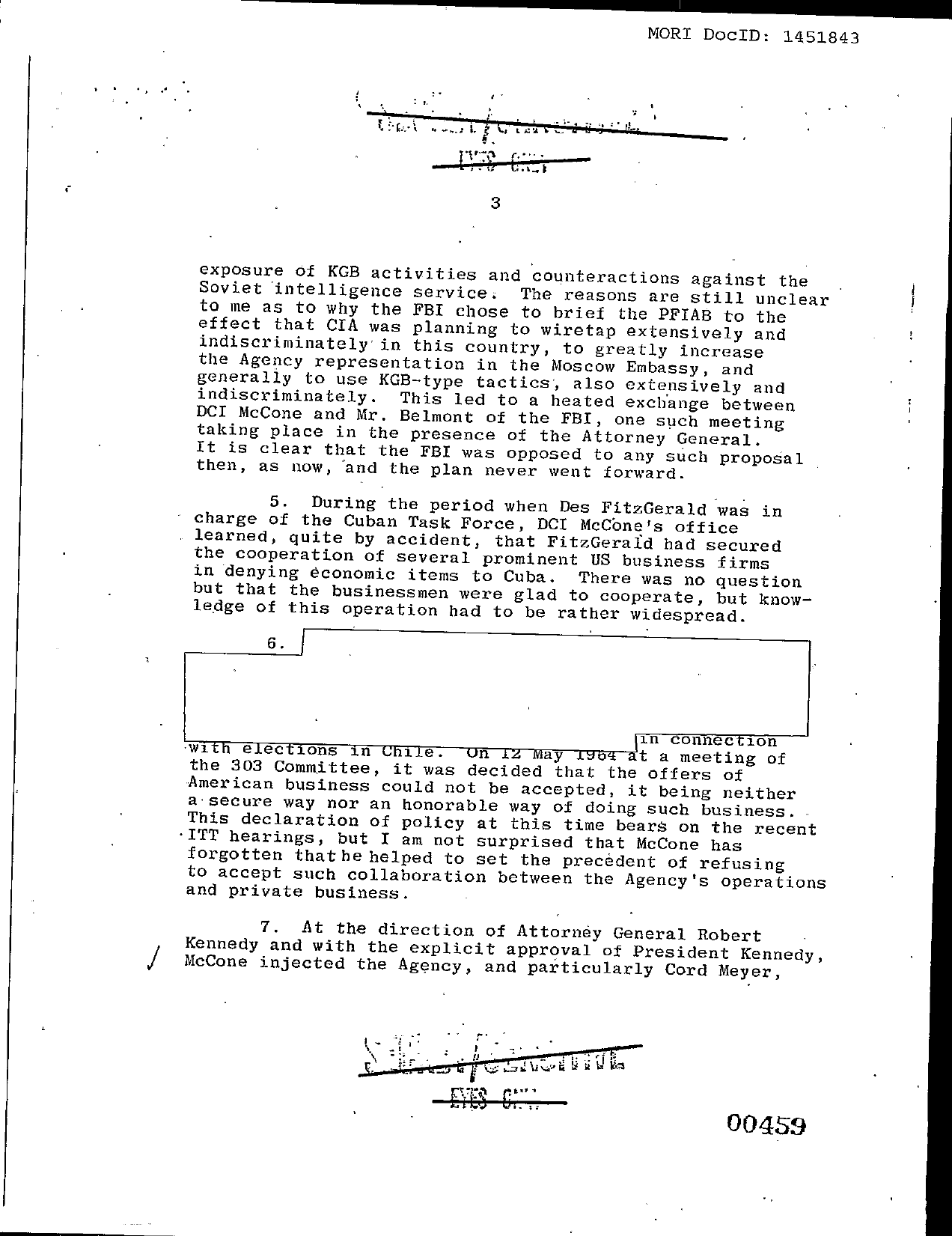
exposure of KGB activities and counteractions against the
Soviet intelligence service. The reasons are still unclear
to me as to why the FBI chose to brief the PFIAb to the
effect that CIA was planning to wiretap extensively and
indiscriminately in this country, to greatly increase
Agency representation in the Moscow Embassy, and
generally to use KGB-type tactics, also extensively and
indiscriminately. This led to a heated exchange between
DCI McCone and Mr. Belmont of the FBI, one such meeting
taking place in the presence of the Attorney General.
It is clear that the FBI was opposed to any such proposal
then, as now, and the plan never went forward.

5. During the period when Des FitzGerald was in
charge of the Cuban Task Force, DCI McCone's office
learned, quite by accident, that FitzGerald had secured
the cooperation of several prominent US business firms
in denying economic items to Cuba. There was no question
but that the businessmen were glad to cooperate, but know-
ledge of this operation had to be rather widespread.

6. [Large blank space in document]

With elections in Chile, on 12 May 1964 at a meeting of
the 303 Committee, it was decided that the offers of
American business could not be accepted, it being neither
secure nor an honorable way of doing such business.
This declaration of policy at this time bears on the recent
ITT hearings, but I am not surprised that McCone has
forgotten that helped to set the precedent of refusing
to accept such collaboration between the Agency's Operations
and private business.

7. At the direction of Attorney General Robert
Kennedy and with the explicit approval of President Kennedy,
McCone injected the Agency, and particularly Cord Meyer,

00459

[vision-ocr]
Carbon-copy typewriter text from 1973, OCR'd by tesseract.js (Leptonica WASM). Errors and missed characters are expected; cross-check against the scan above.