Page 323 of 703
Declassified CIA Family Jewels memo, June 2007 release. OCR transcribed by tesseract.js.
MORI DOCID 1451843
Page image
Source scan from the National Security Archive copy of the document. Open full PDF at this page →
OCR transcript5,233 chars
MORI DocID: 1451843

NEW YORK TIMES
29 MAY 1973

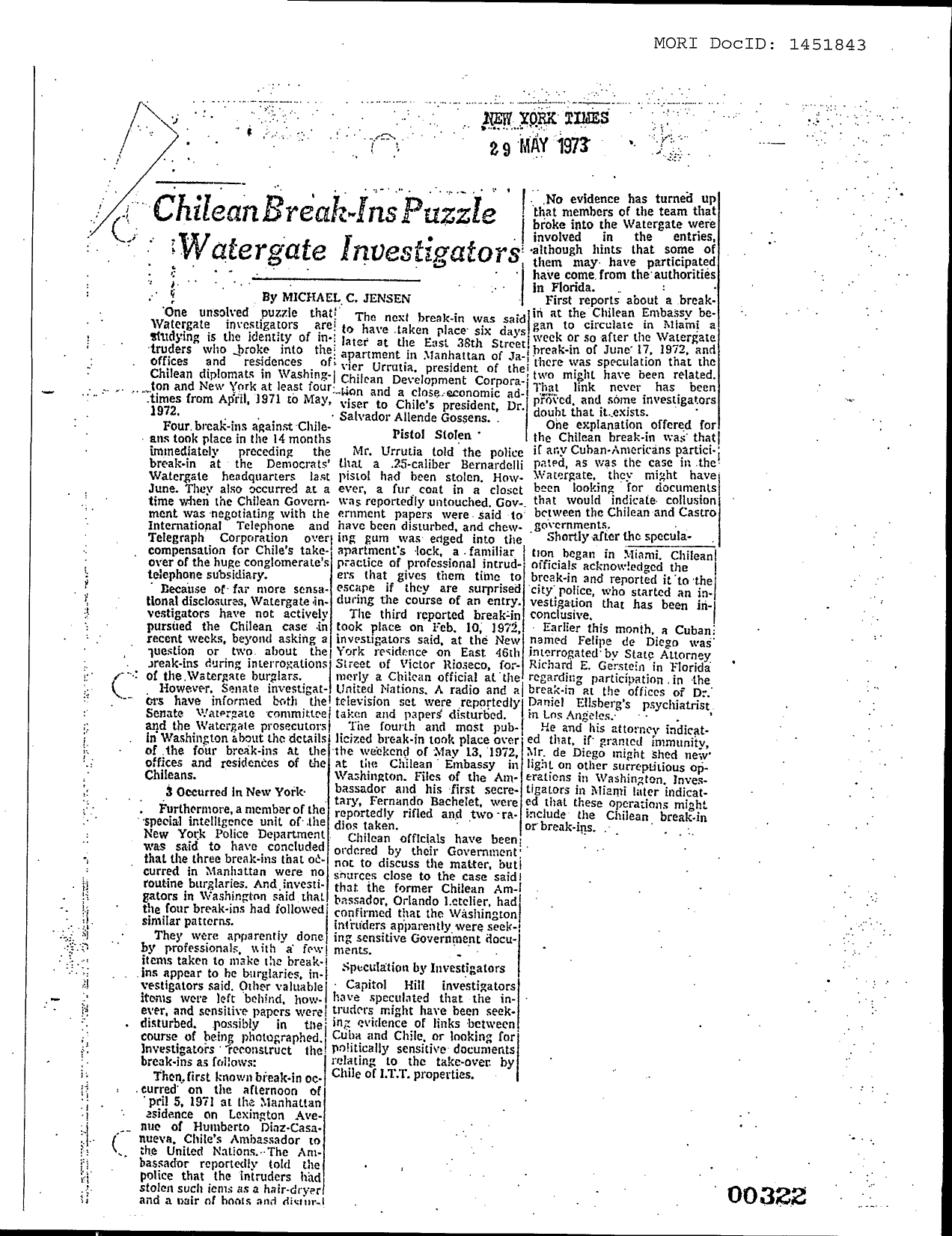
Chilean Break-Ins Puzzle
Watergate Investigators

By MICHAEL C. JENSEN

One unsolved puzzle that
Watergate investigators are
studying is the identity of intruders who broke into the
homes and offices of Chilean
diplomats in Washington and New York at least four
times from April, 1971 to May,
1972.

Four break-ins against Chilean took place in the 14 months
immediately preceding the break at the Democrats' Watergate headquarters last June. They occurred at the home of the Chilean Government was negotiating with the International Telephone and Telegraph Corporation over compensation for Chile's takeover of the huge conglomerate's telephone subsidiary.

Because of far more sensational disclosures, Watergate investigators have not yet pursued the Chilean case in recent weeks, beyond asking a question or two about the graphic during interrogations of the Watergate burglars. However, Senate investigators have informed both the Senate Watergate committee and the F.B.I. in Washington about the details of the four break-ins and the offices and residences of the Chileans.

3 Occurred in New York

Furthermore, a member of a special intelligence unit of the New York Police Department was said to have concluded that the break-ins that occurred in Manhattan were no routine burglaries. And investigators in Washington said that the four break-ins had followed a similar pattern.

They were apparently done by professionals with a few items taken to make the break-ins appear to be burglaries, investigators said. Other valuable items were left behind, however, and sensitive papers were disturbed, possibly in the course of being photographed. Investigators reconstructed the break-ins as follows:

First, a break-in occurred April 5, 1971 at his Manhattan residence on Lexington Avenue of Humberto Diaz-Casanueva, Chile's Ambassador to the United Nations. The Ambassador reportedly told the police that the intruders had stolen such items as a hair-dryer and a pair of boots and a pair of boots and a pair of and a pair and a pair of books and a pair of and a pair of and a hair-dryer

No evidence has turned up that members of the team that broke into the Watergate were involved in the entries, according to published accounts. However, they may have participated have come from the authorities in Florida.

First reports about a break-in at the Chilean Embassy began to circulate in Miami a week or so after the Watergate break-in of June 17, 1972, and suspicions have persisted since then that the two might have been related. That link, however, has never been proved, and some investigators doubt that it exists.

One explanation offered for the Chilean break-in was that if any Cuban-Americans participated, as was the case in the Watergate, they might have been looking for documents showing any communist links between the Chilean and Castro governments.

Shortly after the speculation began in Miami, Chilean officials acknowledged the break-in and reported it to the city police, who started an investigation that has been inconclusive.

Earlier this month, a Cuban exile was arrested in Miami when interrogated by State Attorney Richard E. Gerstein in Florida regarding participation in the break-in at the offices of Dr. Daniel Ellsberg's psychiatrist in Los Angeles.

He and his attorney indicated that, if granted immunity, he might be able to shed new light on other surreptitious operations in Washington. Operatives in Miami later indicated that these operations might include the Chilean break-in or break-ins.

The next break-in was said to have taken place six days later at the East 38th Street apartment in Manhattan of Javier Urrutia, president of the Chilean Development Corporation and a close economic adviser to Chile's president, Dr. Salvador Allende Gossens.

Pistol Stolen

Mr. Urrutia told the police that a .25-caliber Bernardelli pistol had been stolen. However, a fur coat in a closet and a desk with important papers were said to have been disturbed, and chewing gum was edged into the apartment's lock, a familiar practice of professional intruders that gives them time to escape if they are surprised during the course of an entry.

The third reported break-in took place on Feb. 10, 1972 at the New York residence on East 46th Street of Victor Noseco, formerly a Chilean official at the United Nations. A radio and a television set were reportedly taken and most publicized break-in York took place over the weekend of May 20-21 at the Chilean Embassy in Washington. Files of the Ambassador and his first secretary, Fernando Batchelet, were reportedly rifled and two radios taken.

The Chilean have been ordered by their Government not to discuss the break-ins. However, sources close to the case said that the former Chilean Ambassador, Orlando Letelier, had confirmed that the Washington intruders apparently were seeking sensitive Government documents.

Speculation by Investigators

Capitol Hill investigators have speculated that the intruders might have been seeking evidence of links between Cuba and Chile, or looking for politically sensitive documents relating to the take-over by Chile of I.T.T properties.

00322

[vision-ocr]
Carbon-copy typewriter text from 1973, OCR'd by tesseract.js (Leptonica WASM). Errors and missed characters are expected; cross-check against the scan above.